
OpenAI Presence is a managed enterprise product for deploying governed AI agents across voice and chat. It is available now only to eligible enterprise customers through limited general availability; it is not self-serve, and OpenAI has not published standard pricing. Organizations must contact their OpenAI account team and complete workflow, integration, security, testing, and rollout scoping.
This guide explains what Presence does, who can access it, how it differs from ChatGPT Workspace Agents, and what to prepare before contacting sales. It is based on OpenAI’s July 22, 2026 announcement and official Help Center documentation.
OpenAI Presence at a glance
| Question | Verified answer |
|---|---|
| What is it? | A managed platform for building, deploying, operating, and improving governed enterprise AI agents. |
| Which channels are supported? | Voice and chat during limited general availability; exact channels and integrations are scoped per deployment. |
| Is it self-serve? | No. Deployments are led by OpenAI Forward Deployed Engineers, select deployment partners, or both. |
| Who can get it? | Eligible enterprise customers with suitable workflows, implementation readiness, and available delivery capacity. |
| What does it cost? | No public standard price is listed. Pricing and implementation scope are specific to each deployment. |
| Is it the same as ChatGPT Workspace Agents? | No. Presence is a separate managed product for production workflows requiring integrations, evaluations, guardrails, monitoring, and deployment support. |
What can an OpenAI Presence agent do?
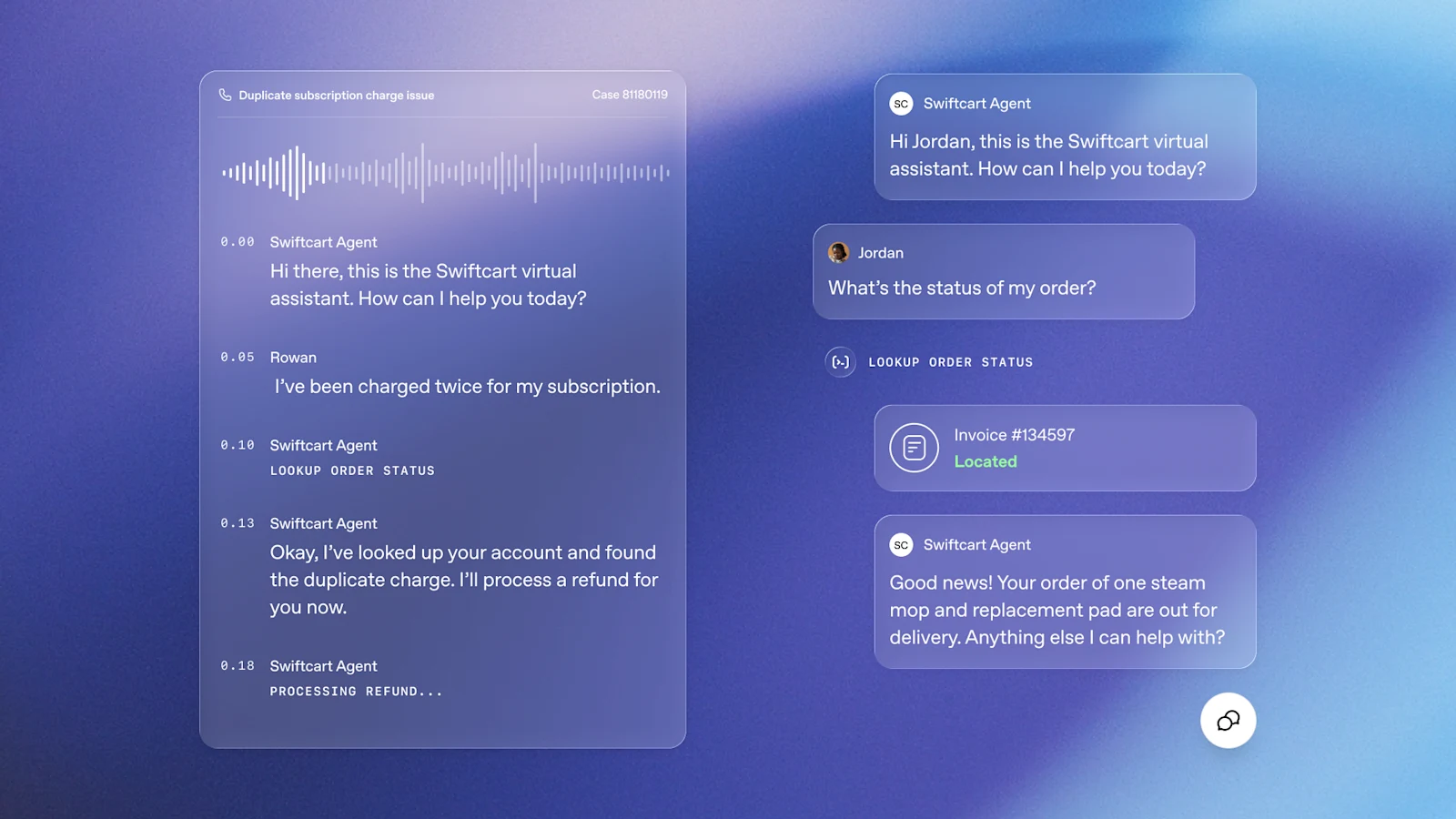
A Presence deployment begins with a defined job rather than a general-purpose assistant. OpenAI gives examples including billing support, insurance claims, employee IT requests, customer support, demand generation, human resources, and procurement.
- Follow approved standard operating procedures and organizational policies.
- Use selected knowledge and connect to business systems through tools and APIs with scoped permissions.
- Retrieve information, update systems, and complete approved actions.
- Communicate through supported voice or chat experiences.
- Request approval or hand a case to a person when policy, risk, or judgment requires it.
The company—not the agent—defines what the system may access, which actions are permitted, when approval is needed, and when a human must take over. Exact capabilities are confirmed during technical scoping.
How Presence controls agent risk
Presence combines OpenAI models with operational controls intended for production use. Before launch, teams can test common requests, edge cases, and higher-risk scenarios using simulations and evaluations. These checks can assess whether an agent reached the correct outcome, followed policy, used tools correctly, and escalated when required.
- Before launch: define policies, permissions, approved actions, evaluation cases, guardrails, and escalation paths.
- During operation: review session records, action histories, escalations, and quality signals.
- When changing the agent: test proposed changes against the production version, use controlled rollout, and retain a rollback process.
OpenAI says Codex can investigate production signals and propose improvements, but teams test and approve changes before rollout. Presence does not become production-ready simply by ingesting documents; OpenAI’s Help Center explicitly says deployment requires scoping, integration, testing, review, and approval.
Presence vs ChatGPT Workspace Agents
| Area | OpenAI Presence | ChatGPT Workspace Agents |
|---|---|---|
| Deployment model | Managed enterprise deployment with OpenAI and/or a select partner | Created and managed within supported ChatGPT and Slack workspace experiences |
| Primary fit | High-volume or high-stakes production workflows | Shared workplace tasks and automations |
| Integration and governance | Custom-scoped systems, permissions, evaluations, monitoring, and support | Workspace-level tools and governance |
| Access | Limited GA for eligible enterprise customers | Depends on the supported ChatGPT plan and workspace rollout |
| Self-serve | No | Workspace users/admins can create and manage supported agents |
Presence is also different from simply building an agent with the OpenAI API. OpenAI continues to offer frontier models through the API, while Presence adds a managed deployment process and production operating layer. The right choice depends on whether your team wants to engineer and operate the system itself or needs a managed enterprise deployment.
Presence readiness checklist
Use this checklist before contacting OpenAI. A narrow, measurable first workflow will be easier to evaluate than a broad request to “automate customer service.”
- Choose one repeatable workflow. Document its start, end, exceptions, volume, languages, and current owner.
- Define measurable outcomes. Examples include resolution rate, average handling time, escalation accuracy, policy compliance, and customer satisfaction.
- Prepare authoritative knowledge. Identify the approved SOPs, policies, product data, and owners responsible for keeping them current.
- Map required systems. List APIs, authentication methods, read/write actions, rate limits, sandboxes, and system owners.
- Apply least privilege. Separate read-only tasks from actions that change accounts, money, access, or customer records.
- Write approval and escalation rules. Specify when the agent must stop, ask permission, transfer to a person, or use another support path.
- Build an evaluation set. Include normal cases, ambiguous requests, policy conflicts, malicious instructions, unavailable systems, and high-risk edge cases.
- Plan human handoff. Decide which context reaches the receiving team, how priority is assigned, and who owns unresolved cases.
- Complete privacy, security, and legal review. Define accessible data, logging, masking, retention, storage location, and access controls.
- Design a staged rollout. Start with a constrained audience or workflow, monitor results, and preserve rollback procedures.
A simple go/no-go scorecard
Score each item from 0 (not ready) to 2 (ready). A low score does not rule out Presence, but it shows what must be clarified during discovery.
| Readiness area | 0 | 1 | 2 |
|---|---|---|---|
| Workflow definition | Broad idea only | Partial process map | Clear, bounded workflow |
| Success metrics | None | Qualitative goals | Baseline and target metrics |
| Knowledge quality | Conflicting/outdated | Usable with cleanup | Approved and owned |
| System access | Unknown | Systems identified | APIs, owners, and sandbox ready |
| Risk controls | Undefined | Draft rules | Approved permissions and escalations |
| Evaluation data | None | Some sample cases | Representative test set |
| Human operations | No handoff plan | Informal process | Owned queue and SLA |
| Security/privacy | Not reviewed | Review planned | Requirements documented |
Interpretation: 13–16 suggests strong discovery readiness; 8–12 means the opportunity may be viable but needs preparation; 0–7 indicates that process and governance work should come before vendor selection. This is an editorial planning tool, not an OpenAI eligibility test.
Pricing, access, and important limitations
- No public list price: OpenAI says pricing and implementation scope are customer- and deployment-specific.
- Limited availability: access depends on workflow fit, implementation readiness, and delivery capacity.
- No self-serve signup: organizations should contact their OpenAI account representative.
- Deployment details vary: exact models, channels, capacity, integrations, data handling, and service commitments are set per deployment.
- Voice and chat today: those are the supported conversational channels during limited GA, with exact contact-center and routing design confirmed during scoping.
Frequently asked questions
Is OpenAI Presence available now?
Yes, but only through limited general availability for eligible enterprise customers. It is not a self-serve product.
How much does OpenAI Presence cost?
OpenAI has not published a standard price. Pricing and implementation scope are defined for each customer and deployment.
Does Presence support both voice and chat?
Yes. OpenAI says Presence supports conversational workflows through voice or chat during limited GA. Exact channels, routing, authentication, and integrations are confirmed per deployment.
Can small businesses sign up?
There is no public self-serve signup. OpenAI describes Presence as an enterprise product for high-scale, repeatable workflows requiring governance and operational oversight. Organizations must discuss eligibility with an OpenAI account representative.
Is Presence just a chatbot?
No. A configured agent can use approved company systems, retrieve or update information, complete authorized actions, follow policies, and escalate to people. Its exact permissions and capabilities depend on the deployment.
Official sources
- OpenAI: Introducing OpenAI Presence (July 22, 2026)
- OpenAI Help Center: OpenAI Presence
- OpenAI Presence product page
Last verified: July 23, 2026. Availability and product details can change; confirm deployment terms directly with OpenAI.