
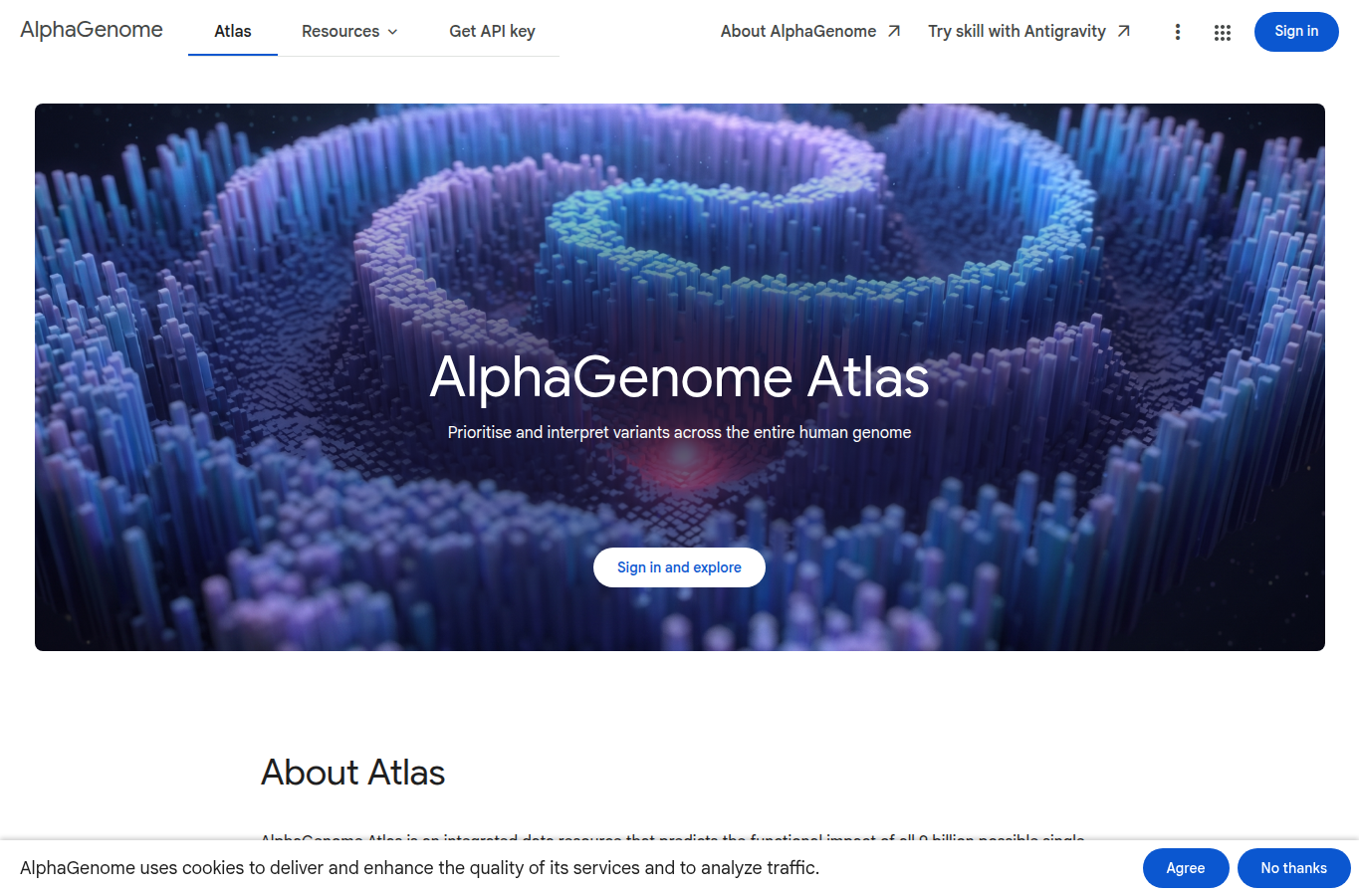
Direct answer: Google DeepMind launched AlphaGenome Atlas on September 8, 2026. Researchers can sign in to the free web portal to explore precomputed predictions for all 9 billion possible single-nucleotide variants (SNVs) in the human genome, including one AlphaGenome Variant Impact (AVI) score for prioritising variants.[1][2][3]
Important: AlphaGenome Atlas is a research tool, not a medical test. Google says its predictions are for theoretical modelling and research only, are not validated or approved for clinical use, and must not be used for diagnosis, treatment, or clinical decision-making.[2][3]
Quick access
- No-code Atlas: Open AlphaGenome Atlas.[3]
- Python/API: Open the official AlphaGenome repository.[4]
- Paper: Read the AlphaGenome paper in Nature.[5]
- Best for: research variant prioritisation, regulatory-effect exploration, and forming hypotheses for experimental validation.[2]
- Not for: personal health interpretation or clinical decisions.[2][3]
What is AlphaGenome Atlas?
AlphaGenome Atlas is a one-petabyte, precomputed map of predicted molecular effects for every possible one-letter change in the human genome. DeepMind describes it as more than 30 times larger than the AlphaFold Database.[2]
The Atlas adds a genome-wide layer on top of the existing AlphaGenome model. Instead of asking the model to calculate one region or variant at a time, researchers can begin with predictions that DeepMind has already generated across the genome.[2]
Its main components are:
- Molecular-effect predictions: predicted effects across gene regulation, gene expression, RNA splicing, chromatin features and other modalities.[2]
- AVI score: one standardised score intended to help researchers rank variants by predicted impact.[2][3]
- AVI feature attributions: clues about which predicted biological features contributed to the score.[2]
- DNA sequence motifs: more than 2,500 recurring sequence patterns and their genomic locations.[2]
The AVI score combines predictions from AlphaGenome with AlphaMissense, allowing one ranking system to cover both protein-coding and non-coding regions.[2]
How to use AlphaGenome Atlas without code
1. Open the official portal
Go to deepmind.google.com/science/alphagenome/atlas. The page describes the Atlas as a zero-code tool for spot-checking individual variants and examining their genomic context.[3]
2. Sign in
Select Sign in and explore and use a Google account. Access and use remain subject to the AlphaGenome Services terms.[3]
3. Start with a precisely defined research variant
Prepare the genome build, chromosome, genomic position, reference allele and alternate allele used in your research data. Confirm those fields against your source dataset before interpreting any prediction; a coordinate or reference-build mismatch can point to a different genomic location.
4. Review the AVI score and its feature attributions together
Use the AVI score as a prioritisation signal, not as a diagnosis or a final pathogenicity verdict. Then inspect the accompanying feature attributions to see whether the predicted effect is associated with processes such as gene expression, RNA splicing, chromatin accessibility or protein impact.[2]
5. Compare the prediction with existing evidence
Check the candidate against your study design, population data, published literature and experimental results. AlphaGenome Atlas is designed to help researchers decide what to investigate next; DeepMind explicitly positions the predictions as a starting point for targeted research and experimental validation.[2]
6. Record the source and version in your research notes
Keep the queried variant, date, genome build, relevant output and the required citation with your analysis. The Atlas page asks users of the website or scores to cite Cheng et al. (2026), while AlphaGenome output users should also cite Avsec et al. (2026).[3]
When should you use the Atlas, API or model weights?
| Option | Best use | Coding required | Key restriction |
|---|---|---|---|
| AlphaGenome Atlas | Fast lookup, ranking and visual exploration of precomputed variants | No | Research use; follow Atlas terms |
| AlphaGenome API | Smaller or medium programmatic analyses and custom visualisations | Yes | Free for non-commercial use, subject to terms |
| Research model code/weights | Academic workflows needing local model access or deeper customisation | Yes | Review model licence and hardware requirements |
| Google Cloud offering | Commercial workflows when supported | Yes | Cloud access, pricing and product terms apply |
The official API repository says the hosted API is free for non-commercial use and is suited to limited regions or variants requiring thousands of predictions, but is unlikely to suit analyses requiring more than one million predictions. It provides Colab notebooks for a quick start and for visualising predictions.[4]
AlphaGenome API quick start
If you need repeatable programmatic analysis rather than a browser lookup:
- Request an API key from the official AlphaGenome site.[4]
- Open the official Quick start Colab notebook from the repository.[4]
- Keep the API key outside source code and notebooks you plan to share.[4]
- Define the genomic interval and variant using a verified reference build.[4]
- Request only the output modalities needed for the research question.[4]
- Save the variant inputs, output metadata and visualisation settings for reproducibility.[4]
The repository also documents local installation, variant-scoring strategies and a visualisation library for generating Matplotlib figures.[4]
What can researchers do with it?
DeepMind reports early research uses in three broad areas:
Prioritise candidate variants in unsolved rare-disease research
Collaborators used the AVI score to rank candidate variants and experimentally validated a predicted splicing effect involving the DNM1 gene. This is an example of research prioritisation followed by laboratory validation—not evidence that an AVI score alone determines whether a variant causes disease.[2]
Study rare non-coding variants and complex traits
In an analysis of more than 54,000 UK Biobank participants, a collaborator grouped rare variants by predicted molecular effect and reported 22% more non-coding associations than the comparison approach described by DeepMind. A separate analysis focused on the 1% of non-coding variants predicted to be most impactful and identified 19 regions for further body-mass-index research.[2]
Explore regulatory DNA motifs
Researchers can use the motif and attribution resources to investigate recurring DNA sequences and infer which regulatory processes may be affected in particular genes or cell types.[2]
What the AVI score does—and does not mean
The AVI score condenses many model predictions into one ranking signal. That can reduce the amount of output a researcher must inspect when triaging a large candidate list.[2]
It does not replace clinical classification standards, patient history, segregation analysis, population-frequency evidence, functional experiments or expert review. DeepMind states that AlphaGenome has not been validated or approved for clinical use.[2]
The underlying AlphaGenome research was published in Nature. The journal’s issue summary says the model accepts one million base pairs of sequence and predicts thousands of human and mouse genomic signals, including gene expression, DNA accessibility and splicing.[5]
Practical research checklist
Before acting on an Atlas result, record:
- [ ] genome build and chromosome notation
- [ ] exact reference and alternate allele
- [ ] AVI score and relevant feature attributions.[2][3]
- [ ] tissue or cell-type context
- [ ] date of access
- [ ] supporting population and literature evidence
- [ ] planned experimental or independent validation
- [ ] AlphaGenome and Atlas citations.[3]
- [ ] confirmation that the use complies with the applicable terms.[3][4]
- [ ] a clear note that the output was not used as medical advice.[2][3]
Frequently asked questions
Is AlphaGenome Atlas free?
DeepMind says the website is available for non-commercial use. The official AlphaGenome API is also offered free of charge for non-commercial use, subject to its terms.[2][4]
Do I need to know Python?
No for the Atlas website. DeepMind describes it as a zero-code portal for individual variant exploration. Python is useful when you need repeatable programmatic queries, custom plots or integration into a research pipeline.[3][4]
What is an AVI score?
The AlphaGenome Variant Impact score is a standardised number that combines coding and non-coding predictions to help researchers prioritise variants. Its feature attributions help explain which predicted molecular effects contributed to that score.[2][3]
Can AlphaGenome Atlas diagnose a genetic disease?
No. DeepMind says AlphaGenome has not been validated or approved for clinical use, and the Atlas must not be used for clinical decision-making or medical advice.[2][3]
Is the Atlas the same as the AlphaGenome API?
No. The Atlas is a precomputed, browser-based genome-wide resource. The API lets researchers send programmatic prediction requests and build custom analyses using the AlphaGenome model.[2][4]
Can companies use AlphaGenome Atlas commercially?
Do not assume that general Atlas outputs are cleared for commercial use. The official Atlas page says outputs and information are non-commercial unless the terms expressly classify an artifact for permissive commercial use. DeepMind says commercial AlphaGenome access is available or planned through Google Cloud, depending on the product path.[2][3]
Bottom line
AlphaGenome Atlas turns AlphaGenome from a query-by-query model into a searchable genome-wide prediction resource. Its strongest practical value is faster research triage: rank variants, inspect the predicted molecular mechanisms, and choose candidates for deeper independent and experimental validation.[2]