
Quick answer: Google launched Gemini for healthcare on November 10, 2026. It is a U.S. preview for healthcare providers and payers, available through Gemini Enterprise Standard and Plus—not a consumer Gemini feature or a clinical tool that an individual patient can switch on.[2][3] It connects approved healthcare and business systems, applies organization-specific skills, and can assemble multi-step clinical-administrative workflows while preserving existing role-based permissions.[2]
If your organization wants to evaluate it, do not begin with autonomous clinical decisions. Begin with one bounded, reversible administrative workflow, synthetic or de-identified test data, named human reviewers, and an auditable success-and-stop plan.
Important: This is an enterprise procurement and pilot-planning guide, not medical, legal, or compliance advice. “Built to support HIPAA compliance” does not make every deployment compliant; your organization remains responsible for configuration, contracts, access controls, validation, and human oversight.
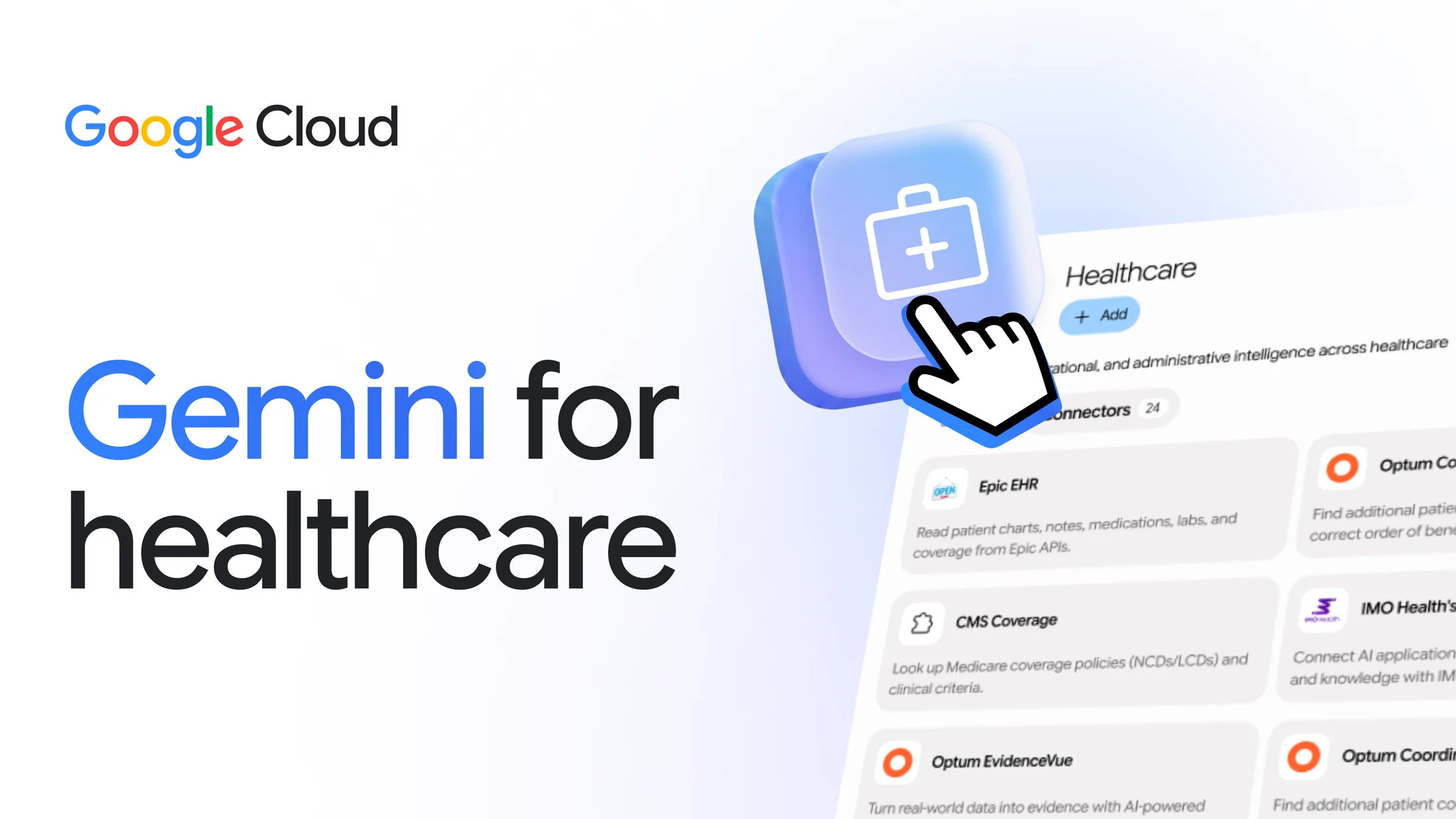
Access status at a glance
| Question | Verified answer |
|---|---|
| Is it available now? | Preview access is available in the United States.[2] |
| Who is it for? | Health systems, medical groups, health plans, providers, and payers.[2] |
| Which plans are eligible? | Gemini Enterprise Standard and Gemini Enterprise Plus.[3][4] |
| Is there a public self-service price? | Google announced per-user subscription and pay-as-you-go options, but the launch material does not publish fixed dollar prices.[3] |
| Is it the normal Gemini app? | No. It is a purpose-built enterprise healthcare solution built on Google’s Gemini agent.[2] |
| Does it replace clinical review? | No. Google describes defined guardrails, traceable evidence, and human oversight.[2][3] |
| Can patients sign up directly? | The announcement describes enterprise access for healthcare organizations, not a direct patient product.[2][3] |
What Gemini for healthcare actually includes
Google describes four main components: healthcare-specific skills, connectors, a partner ecosystem, and a governed agent platform.[2]
1. Reusable healthcare skills
Skills are organization-controlled instructions and context for a defined workflow. Launch examples include medical-record synthesis, pre-appointment preparation, coverage and policy review, prior-authorization support, and payer benefit determination.[2]
These are workflow templates, not permission to let the model make an unsupervised diagnosis, approve coverage, or alter a patient record. A safe pilot should specify exactly what the agent may read, what it may draft, what it may never change, and which person accepts the final result.
2. Connectors to existing systems
The launch material describes connectors for EHR, claims, care-management, administrative, evidence, productivity, and security systems. Google says connectors inherit each source system’s existing role-based permissions and data access rather than replacing them.[2]
The detailed launch release names read integrations for Epic through open.epic APIs and Oracle Health through Ignite APIs for FHIR. It says NextGen Healthcare connectivity is in development, while other partners extend interoperability, eligibility, terminology, pricing, evidence, workflow, productivity, and security functions.[3]
Connector availability is not the same as production readiness. Verify the exact connector, supported data objects, read/write behavior, region, release stage, logging, and contract terms for your environment before including it in a pilot.
3. A governed agent layer
Google says the platform includes fine-grained access controls, policy management, audit logging, grounded responses, and traceable citations. It also says clinical data, prompts, and generated outputs stay in the organization’s governed environment and are not used to train or fine-tune Google’s foundation models.[2]
That is a useful product commitment, but a buyer should still validate identity lifecycle, least privilege, retention, encryption, incident response, subcontractors, export controls, and the applicable Business Associate Agreement with its own security and legal teams.
4. Model choice and task routing
The launch describes model choice across Google and selected partner models, with routing intended to reserve higher-reasoning models for complex work and lower-cost models for routine administrative steps.[2][3]
Ask how model selection is logged, whether administrators can restrict approved models by workflow, how outputs are evaluated after a model update, and whether a workflow can be pinned to a tested configuration.
Practical healthcare AI pilot checklist
Use this as a copyable readiness gate before requesting production access.
Phase 1: Select one bounded workflow
- [ ] Choose a high-volume task with a clear human owner.
- [ ] Prefer drafting, retrieval, reconciliation, or packet assembly over diagnosis or final clinical decisions.
- [ ] Define the exact start event and expected output.
- [ ] List every system and data field the workflow needs.
- [ ] Explicitly prohibit writes, submissions, approvals, patient messaging, or record changes during the first test unless separately reviewed.
- [ ] Define the manual baseline: time, error categories, rework, and escalation rate.
Good first candidates may include preparing a chart-review summary for verification, finding missing prior-authorization documents, organizing a coverage packet, or retrieving cited policy passages. The appropriate choice depends on your organization’s risk assessment and controls.
Phase 2: Complete governance before connecting real data
- [ ] Name an executive sponsor, workflow owner, clinical owner, privacy owner, security owner, and technical owner.
- [ ] Complete vendor-risk, privacy, security, legal, and compliance reviews.
- [ ] Confirm the applicable contract, BAA, data location, retention, deletion, and incident-notification terms.
- [ ] Map source-system permissions and remove unnecessary access.
- [ ] Decide which actions always require a human confirmation.
- [ ] Define prohibited uses and an emergency disable procedure.
- [ ] Record the approved models, connectors, skills, prompts, and test version.
Google states that Gemini for healthcare is built to support HIPAA compliance and that Gemini Enterprise healthcare deployments can support HIPAA requirements under appropriate enterprise controls.[2][4] Those statements support a review; they do not replace one.
Phase 3: Test with controlled data
- [ ] Start with synthetic or properly de-identified cases where feasible.
- [ ] Include ordinary cases, incomplete records, conflicting data, rare edge cases, and adversarial instructions hidden in source documents.
- [ ] Check every citation against the underlying record or policy.
- [ ] Measure omissions, unsupported statements, wrong-patient risk, stale-policy use, permission failures, and reviewer disagreement.
- [ ] Confirm that users cannot retrieve data outside their existing role.
- [ ] Verify that logs show the user, sources, model or workflow version, output, reviewer, and final action.
- [ ] Repeat the evaluation after connector, skill, policy, or model changes.
Phase 4: Use a go/no-go scorecard
Do not rely on an impressive demo. Set thresholds before the trial begins.
| Gate | Example pass condition |
|---|---|
| Evidence | Every material statement links to an allowed source record or is clearly labeled as unresolved. |
| Safety | No unauthorized write, submission, or final decision occurs. |
| Access control | Test users retrieve only data their source-system roles permit. |
| Quality | Error and omission rates remain below the pre-agreed threshold for the selected workflow. |
| Operations | Staff can escalate, correct, audit, and disable the workflow. |
| Value | Verified time or rework reduction exceeds implementation and review overhead. |
A pilot should stop if it produces cross-patient leakage, bypasses source permissions, hides material uncertainty, cannot reproduce its evidence trail, or encourages reviewers to rubber-stamp consequential outputs.
Questions to send Google Cloud or an implementation partner
Copy and adapt this list for procurement:
- Is Gemini for healthcare preview access available for our U.S. organization, plan, region, and use case?
- Do we need Gemini Enterprise Standard or Plus for every participant, and how do per-seat and pay-as-you-go charges interact?
- Which named connectors are preview, limited release, read-only, or generally available today?
- Which EHR objects and FHIR resources can each connector read, and can any connector write back?
- How are source-system permissions, service accounts, break-glass access, and terminated users handled?
- What data is retained in prompts, outputs, logs, caches, and backups, and how is deletion verified?
- Which services are covered by the BAA and which partner services require separate agreements?
- Can administrators restrict models by workflow and retrieve the model, prompt, skill, and connector version from audit logs?
- What human approval controls are available before an agent submits, sends, updates, or triggers another system?
- How are citations generated, and what happens when sources conflict or a required source is unavailable?
- What evaluation tools support regression tests before a workflow or model update reaches production?
- What are the preview support terms, service limits, exit path, and process for exporting configurations and logs?
What not to assume from the launch
- Preview does not mean general availability. Availability, support, connectors, and terms may change.[2]
- HIPAA support does not guarantee compliance. Compliance depends on contracts, configuration, governance, workforce behavior, and the full data flow.
- A connector announcement does not prove compatibility with your deployment. Confirm version, region, permissions, and supported operations.
- Traceable citations do not guarantee a correct conclusion. Reviewers must check whether the cited evidence is complete, current, and applicable.
- No public dollar figure means no verified fixed price. Google announced seat-based and usage-based options; request a written quote for the actual scope.[3]
- Agentic execution should not remove accountable humans. Consequential clinical, coverage, financial, and patient-communication steps need controls proportionate to their risk.
FAQ
Is Gemini for healthcare available outside the United States?
The November 10 launch says the preview is available in the United States. It does not announce a broader-country timetable.[2]
Can an individual doctor or patient use it in the normal Gemini app?
The launch describes an enterprise solution for provider and payer organizations on Gemini Enterprise Standard and Plus. It does not describe a consumer or individual-clinician sign-up path.[2][3]
What does Gemini for healthcare cost?
Google says organizations can choose per-user seat subscriptions or pay-as-you-go pricing, but the launch does not provide fixed public dollar amounts. Eligible buyers should request a scoped quote and confirm which connectors, partner services, implementation work, and usage charges are separate.[3]
Which EHRs are supported?
The launch release describes direct read integrations for Epic and Oracle Health. It says NextGen Healthcare connectivity is in development and identifies additional interoperability partners. Exact support should be confirmed for the organization’s EHR version and workflow.[3]
Does Google train its foundation models on patient data?
Google states that clinical data, prompts, and generated outputs remain in the organization’s governed environment and are not used to train or fine-tune its foundation models.[2]
Should a healthcare organization deploy it directly to production?
A safer approach is a limited pilot with controlled data, least-privilege access, explicit human review, measurable gates, and a tested shutdown path. Preview software and consequential healthcare workflows should not be treated as a plug-and-play deployment.
Sources
[2] https://cloud.google.com/blog/products/ai-machine-learning/gemini-for-healthcare — Introducing Gemini for healthcare
> “Gemini for healthcare is built to support HIPAA compliance, with governance running underneath it all. It’s available starting today in preview.”
> “Gemini for healthcare connects directly to core clinical, operational, and industry systems via secure connectors, inheriting each source system’s existing role-based access controls and data permissions.”
> “Clinical data, prompts, and generated outputs remain within your organization’s governed environment and are never used to train or fine-tune Google’s foundation models.”
[3] https://www.googlecloudpresscorner.com/2026-11-10-Google-Cloud-Launches-Gemini-for-Healthcare — Google Cloud Launches Gemini for Healthcare
> “Gemini for healthcare will be available for Gemini Enterprise Standard and Gemini Enterprise Plus customers”
> “Organizations can scale on their own terms, choosing between predictable per-user seat subscriptions or flexible pay-as-you-go pricing to match their operational budgets.”
[4] https://workspace.google.com/industries/healthcare — Google Workspace: Secure AI for healthcare and life sciences
> “Available in the Standard and Plus editions of Gemini Enterprise.”