
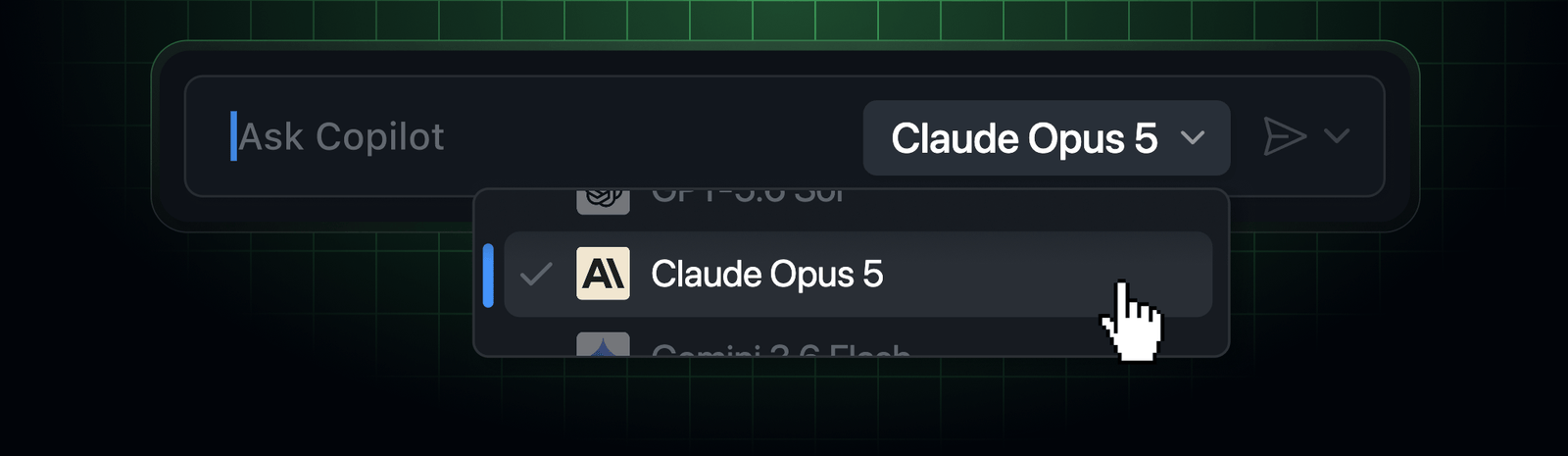
Direct answer: Claude Opus 5 became available in GitHub Copilot on July 24, 2026 for Copilot Pro+, Max, Business and Enterprise users. Open Copilot Chat’s model picker and select Claude Opus 5. Business and Enterprise administrators must enable the Claude Opus 5 policy first. GitHub says rollout is gradual, so an eligible account may not see it immediately.
Five-minute setup checklist
- Confirm that your account has Copilot Pro+, Max, Business or Enterprise—not Copilot Pro.
- For Business or Enterprise, ask an administrator to enable the Claude Opus 5 model policy.
- Update your Copilot extension, IDE, mobile app or CLI.
- Open Copilot Chat and choose Claude Opus 5 from the current-model menu.
- Test it on a branch with the evaluation prompt below; inspect the diff and run the project’s tests before merging.
- Review AI-credit usage because GitHub bills this model at provider API list price under usage-based billing.
Who can use Claude Opus 5 in GitHub Copilot?
| Copilot plan | Access announced? | Action required |
|---|---|---|
| Copilot Pro | No | GitHub’s launch notice does not include Pro. |
| Copilot Pro+ | Yes | Select it in the model picker when rollout reaches the account. |
| Copilot Max | Yes | Select it in the model picker. |
| Copilot Business | Yes | An administrator must enable the Claude Opus 5 policy. |
| Copilot Enterprise | Yes | An administrator must enable the Claude Opus 5 policy. |
Plan eligibility, administrator policy and rollout status are three separate checks. If any one of them is missing, Claude Opus 5 may not appear.
Where the model is available
GitHub lists Claude Opus 5 in the model picker across these Copilot experiences:
- Visual Studio Code
- Visual Studio
- Copilot CLI
- GitHub Copilot cloud agent
- GitHub Copilot app
- github.com
- GitHub Mobile for iOS and Android
- JetBrains IDEs
- Xcode
- Eclipse
The release is rolling out gradually. A missing entry on launch day is not necessarily a configuration failure.
How to enable Claude Opus 5
For Pro+ and Max users
- Open Copilot Chat in a supported client.
- Find the current model dropdown near the chat input.
- Select Claude Opus 5.
- Start a fresh chat if an existing Auto-model session does not switch cleanly.
On GitHub.com, GitHub’s documented flow is to open Copilot Chat, select the current-model dropdown at the bottom and choose the model. In VS Code, open the Chat view and use the same current-model menu.
For Business and Enterprise administrators
- Open the organization or enterprise Copilot settings.
- Find the policy controlling access to Claude Opus 5.
- Enable it for the intended organization or pilot group.
- Confirm members are allowed to switch Copilot Chat models.
- Have one pilot user refresh the client and verify the model picker.
Use a small pilot before broad enablement. Record the policy owner, approval date, eligible repositories, budget limit and rollback decision. GitHub’s launch announcement explicitly says Business and Enterprise administrators must enable the Claude Opus 5 policy.
What Claude Opus 5 is best suited for
GitHub positions Opus 5 for complex, long-running coding work that needs careful reasoning, tool coordination and reliable multi-step execution. In GitHub’s early testing, it performed strongly on autonomous code changes, regression verification and targeted changes that validate their own work while reducing unnecessary execution overhead.
That makes it a sensible candidate for:
- multi-file refactors with explicit acceptance criteria;
- bug fixes that require reproducing the issue and adding regression tests;
- dependency migrations where the agent must edit code, configuration and tests;
- repository analysis that requires several tools or commands;
- careful implementation work where verification matters more than the fastest first response.
These are provider and platform descriptions, not a guarantee for every repository. Evaluate completion quality, review effort, latency and cost on your own workload.
Copy-paste evaluation prompt
Run this on a disposable branch with a clean working tree:
You are working in this repository on a test branch.

Task: Find one small but real reliability issue in the target module I name, then propose the narrowest safe fix.

Before editing:
1. Read the repository instructions and relevant tests.
2. Explain the failure mode and list the files you expect to change.
3. State a measurable acceptance test.

Then:
4. Implement only the targeted fix.
5. Add or update a regression test.
6. Run the narrow test first, then the relevant full test suite.
7. Review the final diff for unrelated edits.

Return:
- root cause
- changed files and why
- commands run with pass/fail status
- remaining risks
- rollback steps

Do not commit, push, change secrets, or modify production infrastructure.
How to compare Opus 5 fairly
| Measure | What to record | Why it matters |
|---|---|---|
| Task completion | Did it satisfy every acceptance criterion? | A polished answer can still miss the requested outcome. |
| Diff quality | Unrelated edits, duplication and reviewer corrections | Smaller, focused diffs reduce review risk. |
| Verification | Tests run, failures investigated and regressions added | GitHub specifically highlights regression verification. |
| Efficiency | Elapsed time, tool calls and retries | Long-running agents can create hidden workflow cost. |
| Billing | AI credits or token cost per completed task | Cheap prompts are not useful if they require repeated retries. |
| Safety | Blocked requests and whether benign context resolved them | Opus 5 has enhanced safeguards for high-harm cyber content. |
Pricing and AI-credit warning
GitHub says Claude Opus 5 is billed at the provider’s API list price under usage-based billing. Anthropic lists the base Claude Opus 5 API rate at $5 per million input tokens and $25 per million output tokens. GitHub converts token usage into AI credits, where its current documentation defines one AI credit as $0.01 USD; included allowances and overage behavior depend on the Copilot plan.
Do not assume that selecting the model is covered by a flat unlimited allowance. Check the organization’s current Copilot billing page and budget controls before a large rollout. Pricing pages can change, so treat the linked official documentation as authoritative.
Why a security request may be blocked
GitHub warns that Claude Opus 5 includes enhanced safeguards for high-harm cyber content. Some cybersecurity or security-adjacent requests may therefore be blocked. GitHub suggests adding clear benign context or choosing another available model when a legitimate request is blocked.
For defensive work, describe authorization, scope, target ownership and the safe output you need. Do not try to bypass safeguards. Anthropic says Opus 5’s controls allow source-code vulnerability finding but restrict some higher-risk activities such as penetration testing and exploit generation.
Troubleshooting: Claude Opus 5 is missing
- Check the plan: the announced list starts at Pro+, not Pro.
- Check rollout timing: GitHub says availability is gradual.
- Check admin policy: Business and Enterprise require explicit enablement.
- Check model-switching permission: Business organizations can control whether members switch models.
- Update and refresh: update the Copilot client, sign out and back in if needed, then open a new chat.
- Check the surface: verify that you are using one of the supported clients listed above.
- Check extensions: GitHub notes that Copilot Extensions can override the selected chat model.
FAQ
Is Claude Opus 5 available on Copilot Pro?
No. GitHub’s July 24 launch notice names Pro+, Max, Business and Enterprise. It does not list Copilot Pro.
Do administrators need to enable Claude Opus 5?
Yes for Copilot Business and Enterprise. GitHub says administrators on those plans must enable the model policy in Copilot settings.
Why can’t I see Claude Opus 5 yet?
The rollout is gradual. Also verify your plan, organization policy, permission to switch models and client version.
Does choosing Claude Opus 5 change inline code completions?
No. GitHub’s model-switching documentation says changing the Copilot Chat model does not change the model used for inline suggestions.
Is Claude Opus 5 unlimited in GitHub Copilot?
Do not assume so. GitHub says it uses provider API list pricing under usage-based billing; included AI-credit allowances and overages depend on the plan.
Official sources
- GitHub Changelog: Claude Opus 5 is now available in GitHub Copilot — availability, plans, supported clients, safeguards and admin policy.
- GitHub Docs: Models and pricing for GitHub Copilot — token billing, AI credits and allowances.
- GitHub Docs: Changing the AI model for GitHub Copilot Chat — model-picker steps and limitations.
- Anthropic: Introducing Claude Opus 5 — model positioning, base API pricing and safeguards.